
Who were the Gepids and the Vandals.
I dedicate this essay to Sofia Khomyn, who inspired me to do this work and provided moral support throughout the creative process.
Near the Anglo-Saxon ancestral home, there were no natural routes for the Anglo-Saxons to migrate south, so they dispersed across the Lesotepnaya zone in small groups. They pushed the Thracians toward the city of Uman, where they concentrated as bearers of the Belogrud culture. The Anglo-Saxon settlements were scattered over a vast area, now dominated by toponyms of Proto-Chuvashi origin. These were left behind by the Proto-Chuvashi, who migrated from Galicia as bearers of the Vysotsk culture. The interaction of the Vysotsk and Belogrud cultures gave rise to the Chernoles culture, which became the basis for the Scythian culture. This culture was adopted by the local population of mixed ethnic origin, whom Herodotus referred to as the Scythian Plowmen. Fig.5. Anglo-Saxon place names and sites os Sosnitsa culture. On the map, the Anglo-Saxon homeland is marked in pink. Yellow dots correspond to Sosnitskaya culture sites (from the map in the Archaeology site), and maroon dots correspond to Anglo-Saxon place names. The administrative centers of the Anglo-Saxon tribe are marked with asterisks. The name of the village of Koniatyn can be interpreted by OE cyne- "king" (as an adverb), originating from Gmc kunja "notable kin" and OE tŭn “fence”, “field”, “yard”. Judging by the name, this settlement was not a simple village, but the residence of the tribal leader and its administrative center (cf. English town originated from tŭn). The tribe's high level of organization is confirmed by two other place names, indicating a division of powers. The chieftain's authority was limited by the existing consultative council, located in the village of Akhtyrka (cf. OE eaht "advice, council, consideration", rice "power, government, kingdom"). The center of spiritual power was Kharkiv (cf. OE hearg "temple, altar, sanctuary"). The reasons for this phenomenon may lie in certain characteristics of the Anglo-Saxon ethnopsychology. It is noteworthy that similar traits were also shared by the Romans, whose ancestors, the Italians, previously inhabited the same area as the Anglo-Saxons.
The presence of ancient Turkic people and Anglo-Saxons in Eastern Europe helps answer some dark questions about European history. This can be seen, in particular, by seeking an explanation for the existence of two Galicias in Europe. The very name of Galicia speaks for itself, originating fron OE gāl "cheerful," "lustful," "indecent," "proud," and eacen meaning "to multiply," "to increase," "to grow," "gifted," "strong," "large," "robust." By combining these variations, the corresponding meaning of the name can be chosen according to one's own understanding, and the result will still be something unusual. But we need to gradually look for the answer to the question posed, starting with Galicia in Eastern Europe. Most of this historical region is now located in Western Ukraine.
During research into the toponymy of Ukrainian Galicia using various languages, it was discovered that Galicia boasts a particularly diverse range of place names of foreign origin, with those of presumed Anglo-Saxon origin being the most numerous. Assuming that other obscure toponyms are also ancient, they are plotted on Google My Maps for ease of analysis. In addition to Old English, Chuvash and Kurdish were used to decipher the place names, as the Proto-Kurds and Proto-Chuvash were also present in Galicia in ancient times (see the section of my site Genesis of Scythian Culture). The map clearly shows that the arrangement of place names is not chaotic but rather reflects a specific system, with fairly distinct clusters and chains (see the map in Figure 1).
Fig.1. Ancient place names of foreign origin in Galicia.
Proto-Chuvash place names are in purple, Anglo-Saxon in red, Kurdish in green, and Gothic in black. Their interpretation is given on the map.
Based on the fact of the presence of the Turkic people in the steppes of Ukraine, it has been established that the creators of the Corded Ware cultures were the Turks, who spread across the vast expanse of Europe from the Ukrainian steppes (see Turkic people as Carriers of the Corded Ware Cultures). During their westward migration, one Turkic tribe remained in Galicia, drawn permanently by the rich salt deposits in the Carpathian region. This tribe was the Proto-Chivash, whose ancestral homeland was on the left bank of the Lower Dnieper. There, they evaporated salt from the seawater of the Sivash Bay and traded it as a commodity among tribes. Having acquired experience in this area, they took up this activity in Galicia. Settling among the previous population, the Turks assimilated it and increased their numbers.
Later, the Proto-Chuvashes became the creators of the Komarovo culture, which, along with others, was part of the Trzciniec cultural community. The largest part of this community was made up of Germans. One of their tribes, the Teutons, that is, the ancestors of modern Germans, inhabited Volhynia; the area to the east, beyond the Sluch River, was populated by Anglo-Saxons (see the map in Fig. 2).
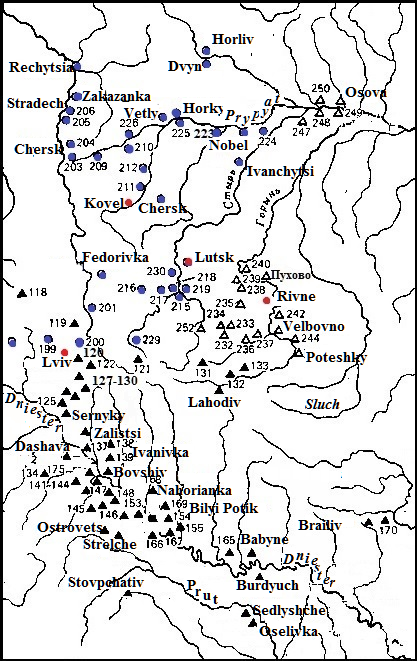
Fig. 2. Spread of sites of Trzciniec and Komariv cultures
A fragment of the map of Archaeology site.
On the map, the sites of some variant of the Trzciniec culture (its creators were the Teutons) are indicated by dark-blue dots. The sites of the Komariv culture are marked with black triangles. The contact area between the Teutons and Anglo-Saxons, who were creators of another variant of the Trzciniec culture (Sosnitsa culture), is indicated by light triangles.
The stay of Proto-Chuvashes in these areas is confirmed by preserved now onomastics (mainly by place names, but partly by anthroponymy), explained well with the help of the Chuvash language. Hypothetical territory of Bulgarish settlement would have to be the area south of the ancient Teutons, that is, in the catchment of the upper Dniester, Western Bug, Zolota Lypa, and Strypa Rivers, that is, in Galicia, which is affirmed by a large list of Chuvash-Germanic Language Connections
By virtue of the inherent logic of its development, the Komarov culture must have transformed into the Vysotsk culture if the creators of both were of the same ethnicity, that is, Proto-Chuvash. Using information from Pasternak, Krushelnytska, and Tsinkalovsky, M. Bandrivsky compiled a large list of high culture sites (BANDRIVSKYI MYKOLA, 1998: 36). They were plotted on Google My Maps along with toponyms of presumed Proto-Chuvash origin. A significant correlation exists between these sites and place names.
Fig. 2. Correlation between archaeological sites of the Vysotsk culture and Proto-Chuwa place names
Sites of the Vysotsk culture are marked with blue dots, toponyms of Proto-Chuvash origin are marked with purple dots.
The map shows that clusters of toponyms largely correspond to clusters of sites, to varying degrees. A large number of Proto-Chuvash place bames were discovered in the Lviv region and further east toward the Gnyla Lypa River, but one cluster is located within the Cherepin-Lahodivk group of sites, which L. Krushelnytska attributes to the Early Scythian culture and M. Bandrivsky to the Vysotsk culture. In the east, two distinct chains of place names extend beyond the Vysotsk culture area, converging near the city of Khmelnyk, and then a whole band of toponyms extends toward the Dnieper. They undoubtedly mark the eastward movement of some Proto-Chuvash people into the steppes of Ukraine.
Only a portion of the Protochucashes' place names can be associated with the Vysotsk culture. The sites are located primarily on the left bank of the Dniester, which may have marked the boundary between two distinct archaeological cultures. Assuming that the Proto-Chuvashes may have also been the creators of some variant of the Hallstatt culture, a search for known sites of this type was conducted in the relevant literature, revealing that the majority of them are located on the right bank of the Dniester. The cluster of Kurdish place names is generally located east of the Proto-Chuvash, but in some places, Kurdish and Proto-Chuvash settlements are interspersed. The combined area of Proto-Chuvash and Kurdish place names corresponds to the area of the Chernolis culture. However, Proto-Chuvash toponymy significantly predominates in this area, suggesting that the Proto-Chuvashes played a major role in the creation of the Chernolis culture. The Kurds migrated west through Galicia, but did not remain there for long. In Western Europe, they became known as the Cimbri, who waged a long war with Rome and then migrated to Britain (see the section Cimbri – Cymry).
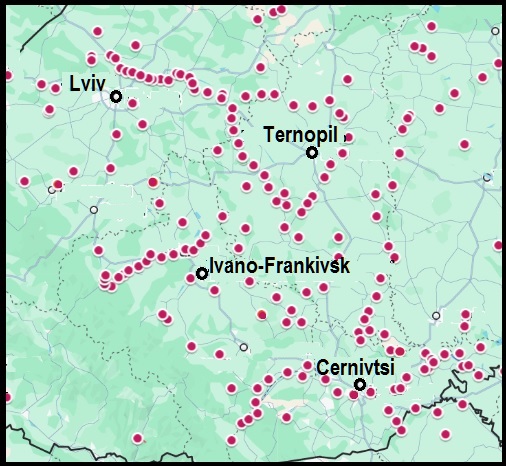
Unlike Proto-Chuvash and Kurdish place names, Old English place names cannot be linked to any specific archaeological culture, but their arrangement exhibits a rare feature. Most of them form clear chains (see Figure 4).
Fig. 4. Anglo-Saxon placd names in Ukrainian Galicia
(Screenshot of part of the map in Google My Maps A Step in Days of Yore. Anglo-Saxon Place Names in Continental Europe)
The Anglo-Saxons migrated through Galicia in two waves. The first included a portion of them, who immediately moved west from their ancestral homeland, while the rest chose other directions (see section Anglo-Saxons in Eastern Europe). The Hunnic invasion triggered the Great Migration, during which those who had previously inhabited the steppes of Ukraine for several centuries and were known in history as the Alans (see section From the Alans to the Svans). It is impossible to distinguish all the toponyms left by the Anglo-Saxons, but their origin in most cases is beyond doubt:
Avratyn, villages in Zhytomyr and Khmelnytskyi Region – OE. æfre "constant", tūn "fence, village".
Bobulyntsi, a village in Ternopil Region – OE bō "both", bylentse "a some plant".
Boratyn, a village in Lviv Region – OE bora "son", tūn "fence, village".
Bulbony, a natural monument of local significance on the right bank of the Dniester reservoir below Khotyn – OE bōl "necklace", bōn "adornment".
Vidnyky, a village in Lviv Region – OE wīdan "from afar".
Husiatyn, a district centre in Ternopil Region and a village in Khmelnytskyi Region – OE hyse "son", "lad", "warrior", tūn "village".
Delatyn, a town in Ivano-Frankivsk Region – OE dǽl, dell "valley", tūn "fence, village".
Drohobych – OE droge "muck", biecnan " "to make signs", biecđ "sign".
Naditychi, a village in Lviv Region – OE nead "necessity", "obligation", "coercion", etan "to eat", eaca "multiply, increase".
Obertyn, a town in Ivano-Frankivsk Region – OE ofer (Ger. ober) "high", tūn "village".
Rakovets, two villages each in Ivano-Frankivsk and Ternopil Regions and one in Lviv Region. – OE racu "channel, current", tūn "село".
Skov'yatyn, a village in Ternopil Region – OE scuwa "shadow, protection", tūn "village".
Skomorokhy, villages in Zhytomyr, Ternopil, and Lviv Regions – OE scumaa "shame", "modesty", "offence", "genitals", reoc "wild", "furious".
Tseliiv, a village in Ternopil Region – OE cele, ciele "cold, frost".
The interpretation of some other toponyms may be less convincing, but when they are located close to one another, questionable cases become more plausible. Subsequent targeted searches in such areas are often successful, especially when toponyms form dense clusters or long chains. We find such chains with sparse toponym density in Western Ukraine (Fig. 4). One such chain extends from Halych to Kalush and further through the Kalush district to Hoshiv in Ivano-Frankivsk Oblast in the following order:
Halych – OE gāl "cheerful," "lustful," "indecent," "proud," and eacen meaning "to multiply".
Krylos – OE griellan "to anger", ōs is the name of a pagan god.
Victoriv – OE wīċ "house, settlement", Þūr/Þōr "Thor, the god of thunder".
Bryn – OE fire "вогонь".
Vistova – OE wist "food".
Khotyn', a district in Kalush – OE heah "high", hoh "height", tūn "fence, village”.
Sivka – OE seaw "juice".
Tuzhyliv OE tulge "strong, hard".
Svarychiv – OE swār "severe".
Low Strutyn' – OE strūtian "to stand firm".
Upper Strutyn' OE strūtian "to stand firm".
Lopianka – OE loppe "spider".
Ilemnia, OE ill "callus", emn/efn from efnian "smooth", "even".
Anhelivka – OE angel "angle, hook".
Lolyn – OE lǣl "прут", "бптіг".
Veldiyh (Wełdzirz), the former name of the village of Shevchenkove – OE weald 1."forest", 2. "power".
Patsykiv – OE pæcan "to deceive", eaca "to grow".
Hoshiv – OE husk "joke".
Gerynia – OE gernan "to need, to desire".
Svicha, a river, rt of the Dnister – OE swiće "fivish".
The chain of Halych-Svich place names may indicate the existence of a trade route along which the Anglo-Saxons established their settlements. The presence of salt deposits in the Carpathian region suggests that salt may have been a commodity along this route. But the salt must have been special, as deposits of common table salt are found in many places, and near Kalush, there are deposits of potassium salts, or potash. Furthermore, in these same areas, potash was also extracted from the ashes of burnt trees. This craft is akin to the production of tar, which, like potash, was a popular commodity. It can be said that these were strategic products of particular importance. Control of such extensive trade could have been exercised by a well-organised society, a kind of quasi-state, which the Anglo-Saxons could have created and led by a ruling elite. This assumption is supported by the unusually high number of surnames of Anglo-Saxon origin preserved in the settlements along this chain. Such surnames are not uncommon in Ukraine, but in this case, the more compelling arguments are those predominantly found in this and neighbouring regions. The following are examples:
Fitsalovych, all seven carriers of this surname live either in Ivano-Frankivsk or in neighbouring districts of the Lviv Region – OE ficol "cunning".
Trambolyak, of the eleven carriers of this surname, nine live in Kalush – OE trem "small thing", būl(a) "adornment".
Izdryk, of the thirteen bearers of this surname, seven live in Kalush. – OE easter "eastern".
Hoshylyk, 56 carriers across Ukraine, almost all in Kalush district– OE husc "joke".
Sturko, 127 carriers across Ukraine, almost all in Kalusa district — OE stōr "strong", "big".
Rymyk, 259 carriers across Ukraine, almost all in Kalusky and neighbouring Tysmenetsk district – OE rīm "number", "account".
Burnych, 599 carriers throughout Ukraine, most of them in Kalush and Kalush district – OE burn "child".
Shymkiv, 1099 carriers throughout Ukraine, most of them in Kalush and Kalush district – OE sćīma "ray, light".
Khomyn, 3286 carriers throughout Ukraine, most of them in Kalush and Kalush district – OE hām, home "home".
Kuz', 3354 carriers throughout Ukraine, most of them in Kalush and Kalush district, 4349 carriers of the derived surname Kuzyk are migrants to neighbouring regions – cwic, "alive, brisk".
Another well-defined chain of Anglo-Saxon place names borders Galicia to the north. The following, stretching eastward, have the most convincing interpretation:
Zhovkva – OE geow "kite", -gē (Gmc *gaw-ja) "area, landscape".
Soposhyn – OE sopa "sip", scīn "light".
Mervychy – OE mǣre "border", wīc "village". The name itself speaks of the purpose of the village.
Nadychi – OE nead "ecessity, obligation, coercion", eaca "multiply, increase".
Vidniv – OE wīdan "from afar"
Tseperiv – OE ciepan "buy, trade"
Kizliv – OE cisel "pebble".
Marmuzovyschy – OE māra "", mūs "mouse".
Skvariava – OE swār "heavy", āwa "always".
This was a defensive line against the advancing Goths, who were moving from the Baltic region in search of a convenient settlement site. The historical sites of their settlements and their movement into the Ukrainian steppes are also marked by toponyms. One of them is located immediately before the Anglo-Saxon chain. The Gothic migration was slow, but it posed a threat to the Anglo-Saxons. The Goths were the creators of the Wielbark culture, whose territory reflects the movement's direction to the southeast. Along with others, it is shown in Fig. 5.
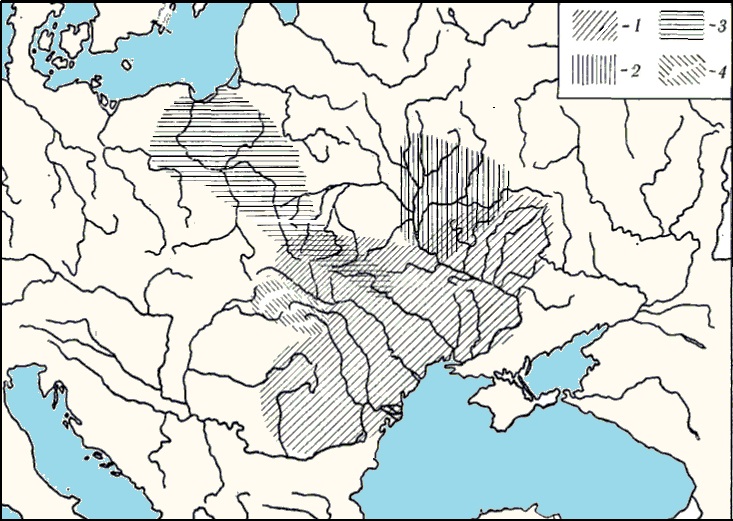
Fig. 5. The area of archaeological cultures of the second quarter of the 1st millennium AD.
Legend: 1 – Chernyakhiv culture, 2 – Kyiv culture, 3 – Velbar culture, 4 – Carpathian mound culture (BARAN V.D. (Ed). 1985, 46, рис. 8).
The construction of a defensive line testifies to the Anglo-Saxon state policy, which presupposed the existence of an information network and controlled local government. This policy prevented the Goths from settling in Galicia and determined their subsequent history. Not far from Zolochiv, this chain branches. One branch continues the defensive line that forced the Goths to advance farther into Podolia. The second branch, returning to the southeast, is lost among other Anglo-Saxon place names. Gothic settlements begin only beyond the Zbruch River, along which Anglo-Saxon place names stretch. Initially, this may have been one of the migration routes of the Anglo-Saxons from their ancestral homeland to Galicia, but it later acquired defensive significance.
When we trace history using toponymy data, in the absence of historical documents, we need to use cartographic information that goes back to ancient times, in particular, the map of the ancient Greek scientist Claudius Ptolemy, published around 150 AD. e. He could have known the cities following the trade routes along which the rivers were at that time. Now the names given by him do not have a reliable interpretation when using the languages of those peoples who, according to the generally accepted but erroneous opinion, dwelled in the Northern Black Sea region and migrated to new places of residence a long time ago. The population along the communication routes could change throughout history, and the names of cities could be changed. Dull villages far from major roads, where a permanent population of one ethnicity lived, were unknown to ancient historians. The stability of the population ensured the preservation of the original names, which were adopted by the new arrivals. However, large cities could keep their names until our time, even in some slightly different form, and the names that have disappeared must be deciphered using Old English or Chuvash. Let's check this assumption by analyzing Ptolemy's map (see Fig. 6).

Fig. 6. Fragment of Ptolemy's map
Ptolemy's map captures only a small part of Galicia, however, relevant information can be found in the names of the cities shown on it:
Carrodunum – OE carr “stone. rock”, dūn “height, hill.” The modern city of Horodenka is located approximately here, and on its outskirts is Red Mountain.
Maelonium – OE meolo “flour”, the city of Melnytsia Podilska (Podilska Mill) is located on this site. Apparently, flour milling has existed here for a long time.
Arcobadara – Lat. arca "money chest, treasury", OE earc(e) "box", bādere "збирач податей". Apparently, the Old English word was borrowed precisely in Scythian times
Clepidara – OE clipian "to speak, to shout", deor "beast".
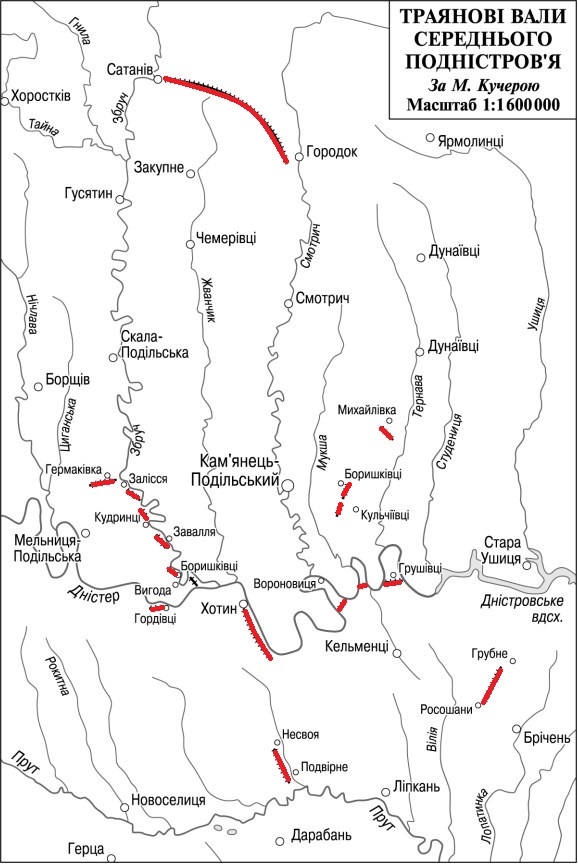
Trifulum – OE đri “three” fulla "height, elevation". Here, the Dniester makes three loops. Thus, three hills are formed, which are separated from the low banks by a ditch and a rampart, which have survived to this day, and stretch across the loops from bank to bank of the river. There are many such ramparts in Transnistria in different places, and they are called Trajan's Walls:
Мал Fig. 7 Trajan's Walls of Middle Transnistria (ZHARKIKH M.I. 2013: 141). On the original map of M.P. Kuchery, the author tinted the shafts red for clarity.
In the early 1990s, the Dniester expedition of the Lev Society (Lviv) was specifically engaged in searching for and describing the ramparts on the banks of the Dniester and its tributaries. The results of the work are described in a collective monograph (DORONKIN ANDRIY. 1998). While studying the history of the embankments, one of the expedition participants explains the origin of such a name:
Trajan's Walls is the name adopted in literature for the long ramparts on the territory of Ukraine, Moldova and Romania. This name, which has a clerical origin, arose in the 18th century due to the certainty of scholars of that time that the long ramparts in Budzhak were built by the Romans (see Ancient Rome) during the reign of Emperor Marcus Ulpius Trajan, and was then transferred to the long ramparts of Transnistria. (ZHARKIKH M.I. 2013: 140).
The Dniester expedition was mainly interested in those ramparts that were built in prehistoric times and that limited quite large territories. In addition to the mentioned one, there were other folk names for ramparts: "Turkish ramparts", "Trajans" (DORONKIN ANDRIY. 1998: 102). In his work, Doronkin mentions the remains of many ramparts that are not shown on the above map. Bringing them into a separate system is a difficult task, especially since they can be attributed to different times. However, it was noticed that in some places, together with steep banks, they form a continuous line of defence (as an example, see the diagram in Fig. 8).
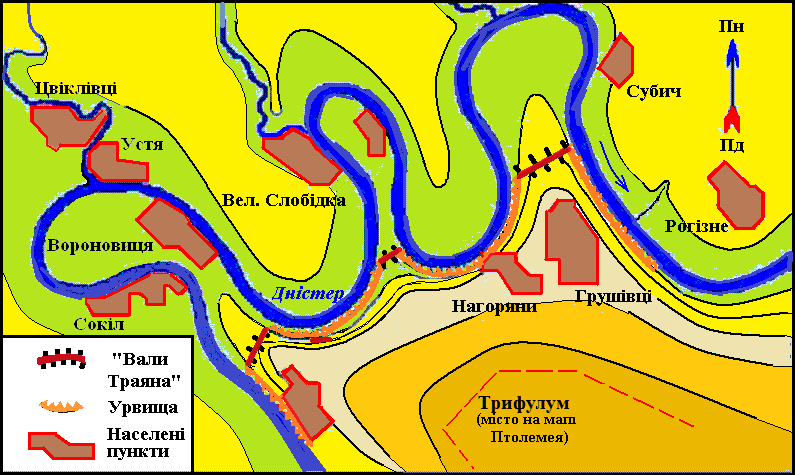
Мал. 8. Fragments of "Trajan's Walls" on the right bank of the Dniester in the Kelmensky district of Chernivtsi region.
(From the report of the expedition "Dniester" of the Lion Society, Lviv city).
The burgundy lines indicate artificial defensive structures (moat and rampart).
The red lines are the steep banks of the Dniester.
The black horizontal lines indicate a height of 200 m above sea level.
Such combined defensive lines may have existed on the Dniester and elsewhere. Specifically, a closed defensive line is formed by the Dniester, the left tributaries of the Zbruch and Nichlava, along with man-made ramparts in places where the banks of these rivers are gentle. Overall, the configuration of the ramparts may reflect the complex relations between the Anglo-Saxons and the Goths, which Jordanes must have touched upon in his Getica. He once mentions the city of Galtis, which some scholars associate with Halych. Who first did so is irrelevant, as this view is not widely supported. However, it is important to have a general understanding of the relationship with neighbours, and I will cite the passage in the history where Galtis is mentioned.
Then Ostrogotha, king of the Goths, who was a man of firm mind, answered the ambassadors that he did indeed dread such a war and that it would be a grievous and infamous thing to join battle with their kin, but he would not give up his lands. And why say more? The Gepidae hastened to take arms, and Ostrogotha likewise moved his forces against them, lest he should seem a coward. They met at the town of Galtis, near which the river Auha flows and there both sides fought with great valor; indeed, the similarity of their arms and of their manner of fighting turned them against their own men. But the better cause and their natural alertness aided the Goths. Finally night 100 put an end to the battle as a part of the Gepidae were giving way. Then Fastida, king of the Gepidae, left the field of slaughter and hastened to his own land, as much humiliated with shame and disgrace as formerly he had been elated with pride. The Goths returned victorious, content with the retreat of the Gepidae, and dwelt in peace and happiness in their own land so long as Ostrogotha was their leader (JORDANES: 99-100)
Jordan calls the Gepids relatives, so it was a Germanic tribe. Were they not Anglo-Saxons? The name of their king, Fastida, can be explained in any Germanic language, but it is not possible for their ethnonym, and the interpretation is possible only in Old English – OE geap "open, distant, wide, spatial, widespread", ead "wealth, happiness, well-being". So, we can see the similarity of the ethnonym and the name of the capital and come to the conclusion that the Gepids are the Anglo-Saxons, Galtis is the Halych, and the defensive line at Trifulum was intended to protect them from the Goths.
The further history of the Anglo-Saxons of Galicia should be seen in the deeds of the Gepids, an idea of which can be formed based on available historical documents. From them, factual material can be taken, primarily the names of their kings:
Fastida, ruled around 250 AD – the first part of the name contains the Proto-Germanic root fastu "strong", present in all Germanic languages. The second part is the same as in the ethnonym, i.e. ead "wealth, happiness, prosperity". This word comes from Gmc. auđan, derivatives of which are present in some Old Germanic languages (Goth. auđa-hafts "endowed with happiness").
Ardaric, who died around 460, was an ally of Attila, the king of the Huns. Together with the Huns, the Gepids went on a campaign to Western Europe and on their side participated in the Battle of the Catalaunian Fields (451); with them, Alaric made a raid on Northern Italy. After the death of Attila, he led a rebellion in 454 against the new Hunnic ruler Elak and won a decisive victory in the battle of Nedao (Pannonia). After this, the Hunnic rule came to its logical end, and Ardaric founded his own state. Galicia was probably part of it. The Eastern Roman Emperor Marcian recognised the state. Under the OE -rīc and Goth. *rīk, which are used in proper names meaning of "king", the name Ardaric corresponds well to the OE eard "state", "fate", which has parallels in relict words of some Indo-European languages (e.g. Greek ἄρτι "directly", "near", "first"), in Middle High German art "innate property", "nature", "origin", manner"). Three Byzantine commanders, who are said to have been either Alans or Goths, had a similar name, Ardabur.
Giesm (Lat. Giesmus? Gr. Γιέσμος, that is Hiesm), died before 488 – Chuv. ie "evil spirit", sĕm "darkness". The Proto-Chuvashes could have been in the Gepid army.
Traustila died in 488 – Old English treowa "fidelity, faith, trust", "duty, alliance", "protection", similar to words in other Germanic languages. The second part of the name can be matched by words from West Germanic, Slavic and Baltic. However, there is some confusion with this name (Traustila or Trapstila). It is stated that he was a Goth or a Hun.
Thrazaric (488 – 505), son of Traustil, after whose death in the war with the Ostrogoths, he led the kingdom. In time, he also lost the war with the Ostrogoths – OE đracu "ressure, violence,". The name of his co-ruler, Hunderith, consists of words from different languages, but of similar meaning – Chuv. khuntă 1. "protector", "deputy", "patron". 2. "help", "facilitation"; and OE riđ "favor, favor", "condescension"; it says a lot.
Elemund, died in 548 – OE hǣle "good, happiness", mund "hand", "protection", "safety". Both words have equivalents in other Germanic languages.
Torisvint, Thurisind (548 – 560) – OE Đōr "thunder god", swīđ "strong", "powerful", M.H.G. swind "powerful".
Cunimund (560 – 567) – OE. cyne-, O.H.G. kuni "royal", Goth. kuni "community", "kind".
The given interpretations of the names of the Gepid kings do not contradict the conclusion about the Old English origin of the Gepids, and archaeologists should know what ethnicity the creators of the cultures they study were. There were reports on the Internet that in the village of Buzovytsia, Dniester district, Chernivtsi region (this is exactly on the site of Trifulum), archaeologists found one of the largest settlements of late antiquity in Ukraine. In the immediate vicinity, several toponyms can also be deciphered using Old English:
Kelmentsi, a district center in Chernivtsi Region – OE gielm "handful", "bundle, sheaf".
Lenkivtsi, a village in Dnister district of село у in Chernivtsi Region – OE leng "length, height".
Vartykivtsi, a village in the same district – OE weard "guardian, shepherd, protector."
Putsita, river, right tributary of the Dniester in Chernivtsi region – OE pucian “to crawl”, tā/tōh “stringy”. This combination of meanings already speaks of the correctness of the interpretation, but one of the streets in the city of Borovichi, Novgorod region in Russia, has the same strange name. It could equally well be the name of both the river and the street, and this removes all possible doubts. The treasure of Kufic dirhams found in Borovichi and the closest toponymy also speak of the presence of the Anglo-Saxons in those places.
Restev-Ataki, the former name of the village of Dnistrivka in the Dnistrovskyi district of Chernivtsi Region. – OE rest "rest, calm", eow "yew tree".
Now let's move from Galicia (Eastern Europe) to Galicia (Spain). Of course, the existing explanation of its name from some Celtic language seems convincing and logical, but the striking similarity of the names is striking. The Anglo-Saxons arrived in Spain as the Alans, along with other Germanic tribes, and their presence there is confirmed by toponymy (see From the Alans to the Svans), but those located in Galicia raised some doubts. During additional searches there, several were unexpectedly discovered that can be explained in Chuvash. Following the initial discoveries, targeted searches for other place names of supposed Proto-Chuvash origin continued, and it turned out that they form a genuine chain:
Jaka, a city of northeastern Spain in the province of Huesca – Chuv. yaka "smooth, even".
Haro, a town in the northwest of La Rioja province in Northern Spain. – Chuv. hăra "fear", "anxiety", "cowardice".
Sahagún, a town, a part of the autonomous community of Castile and León in Spain – Chuv. săkhă "notch, mark", kun "day".
Asturias, Astorga, a city in the Province of León – Chuv. astaru 1. "enticement, enticing" 2. "temptation".
El Barco de Valdeorras, a municipality in the province of Ourense, in the autonomous community of Galicia – Chuv. parka "thick", "fuerte", "strong".
Valdeorras, a comarca in the Galician Province of Ourense – Chuv. vălta "fishing rod", "fishing hook".
Camba, a town 18 km north of Verin – Chuv. kămpa "mushroom".
Verin, a town in the southeast of the province of Ourense, in the autonomous community of Galicia – Chuv. věrene "maple".
Támega, the river on the banks of which Verin is located – Chuv. tamak "mouth".
Chaves, a city in the north of Portugal – Chuv. shăvăç "tin, sheet metal".
This unexpected development may seem unintelligible unless you realise that the Anglo-Saxons and the Protochniki (Proto-Chuvash) settled Ukrainian Galicia together, suggesting some connection. The chain of Proto-Chuvash toponyms suggests that the Chuvash must have moved together with the Anglo-Saxons. According to historical documents, during the Great Migration, Galicia was settled by the Suevi and the Asdingi Vandals. The Suevi are considered Germanic and could have been a branch of the Anglo-Saxons, while the ethnicity of the Vandals remains unclear. In a review of one of the most recent works on this issue (STEINACHER ROLAND. 2018), he concludes that "the final point has not yet been put" (WILCZYŃSKI MAREK. 2018: 173). This implies that they do not necessarily have to be Germanic.
Since the Vandals, unlike the Ostrogoths, Visigoths, and Lombards, lacked their own historiography and left no traditions behind, their ethnicity was difficult to determine. Austrian scholars have been particularly active in addressing this issue (BERNDT GUIDO M./STEINACHER ROLAND. 2008). Various approaches have been taken in this search:
Walter Pohl noted that ethnic identity in late antiquity was based on the social interaction of a limited elite. This view significantly reduces the importance of the idea of traders among nations, as it reduces ethnic identity to a social mechanism that is constantly reproduced within a small group of leaders. Applying these ideas to vandals in the North African provinces gives a complex picture (STEINACHER ROLAND. 2018).
Historically, it has been generally accepted that the Vandals were an ancient Germanic confederation of tribes, linguistically similar to the Goths, who emerged onto the world stage during the Great Migration. Some scant information about them can be found in historical documents, and among them, in addition to the ethnonym, one can find several proper names that could be interpreted in Gothic, if it is sufficiently close to Vandal. The Gothic vocabulary has been preserved in limited detail, so other Germanic languages must be included in the explanation, which may confirm that the Vandals were Germanic. The closest pronunciation to the ethnonym is German wandeln "to walk," "to leave," "to stroll." It is impossible to find good equivalents for words with this root in other languages. )KLUGE FRIEDRICH, SEEBOLD ELMAR. 1989: 794), and the meaning of the word itself is not very suitable for an ethnonym, and it is not accepted in science.
Considering toponyms of possible Proto-Chuvash origin, we will attempt to explain the ethnonym "Vandals" in the Chuvash language. The best root is in Chuv. vantă, dialect. văda "аishing basket", -lă is a very productive affix, which from nominal stems forms adjectives with the meaning of the attribute indicated in the original stem. In our case, Vandals could have been people engaged in fishing with a net. This is somewhat questionable for a warlike tribe, but such an interpretation is supported by the similar meaning of the name of the region of Valdeorras (see above). Further confirmation of the Chuvash origin of the Vandals is found in some names of their kings.
Wisimar, King of the Vandals-Asdings (died in 335) – Chuv. viçe "measure", "size"; mar "empty", "insignificant".
Godagisl, King of the Vandals (died in 407) – the name is definitely Germanic – OE god "god"; gīsl "hostage". It is not surprising that the Vandals were considered Germans.
Guntharîx, Gunderic, King of the Vandals-ASdings (407–428) – Chuv. khuntă 1. "protector", "deputy", "patron". 2. "help", "facilitation"; OE -ric "king". Cf. Hunderith.
Gaiseric, King of the Vandals and Alans (428–477), creator of the Vandal and Alan kingdom in North Africa, under whom the Vandals sacked Rome in 455, "king of lands and seas" (STEINACHER ROLAND. 2018: 79) – Chuv. khay "decorate"; çěr "earth".
Hunerix, King of the Vandals and Alans (477–484), eldest son of Gaiseric – Chuv. khuna "to breed", "to multiply", OE. -ric "king".
Gento, Prince of the Vandals, third youngest son of Gaiseric (430–477) – Chuv. khěn "torment", "disease", "oppression", from OT qyn "punishment" [YEGOROV V.G. 1964; 298, NADELIAYEV V.M., et al. 1996: 444]; tu "to do".
Gunthamund, King of the Vandals (484 – 496) – Chuv. huntă 1. "protector", "regent", "patron". 2. "help", "assistance"; OE mund "hand", "protection". In terms of meaning, the Chuvash word closely matches Old English, but the phonetic mismatch raises doubts. Its origin is unknown; it is not considered in etymological dictionaries [YEGOROV V.G. 1964., FEDOTOV M.R. 1996]. Phonetically, it resembles Ger. Kunde "buyer, client", which in trade relations is understood as assistance. However, the origin of the German word foom Gmc. *kunþa "known" [KLUGE FRIEDRICH, SEEBOLD ELMAR. 1989: 419] is very doubtful. It is possible to think that both Chuvash and German words are borrowed from a common source. Such a source can be the language of Tripolians, and such examples are already known (see An Unknown Semitic Tribe in Ancient European History). With this in mind, we are looking for a correspondence in Hebrew. It can be Hebr קונה (kuna) "buyer", derivatives of which can be German and Chuvash words. In this case, the introduction of the Chuvash word to the interpretation of the name Gunthaund is well justified.
Thrasamund, King of the Vandals (484 – 496) – OE đracu "ressure, violence"; mund "hand, protection". Cf. Thrazaric above
Hilderix, King of the Vandals (484 – 496) – OE hild "war", -ric "king".
Gelimer, король вандалів і аланів (530–533) – Chuv. khaylav "skill", "ability", "art", khyr "good".
As can be seen, the names of both the Vandal and Gepid kings, in whole or in part, can be interpreted in Old English and Chuvash. They do not provide a clear indication of the kings' ethnicity. Mixed marriages may have occurred within the ruling elite, and some names may have been fashionable. Nevertheless, it must be assumed that the Gepids were primarily Anglo-Saxons, and the Vandals were a branch of the Gepids.
In Spain, the historical region of Andalusia is associated with the Vandals, so their traces should stay in toponymy there as well. And so it is. Several place names with a possible Proto-Chuvash origin form a small but compact cluster:
Huelva, the capital of the province of Huelva – Сhuv. khümella "fenced".
Jerez de la Frontera, Jerez de los Caballeros, Jérez del Marquesado – Сhuv. khěr "girl", ĕç "work".
Malaga, the capital of the province of Malaga – Сhuv. mal "front", "forepart", aka "arable land", "sowing".
Sevilla, the capital of the province of Sevilla – Сhuv. sěvel "to strip, to remove the bark", "to clean", -la is an extremely productive affix that forms adjectives and adverbs.
The location of the Vandal homeland is controversial, although archaeological finds may at least provide grounds for speculation. Certain artifacts and burial customs suggest it constituted something of a cultural province. It is associated with the Przeworsk culture, named after the most important archaeological site near Przeworsk in southeastern Poland. The main territory was located in central and southern Poland, bordered by the Oder River to the west, the Western Bug River and the upper Dniester River to the east, and the Carpathian Mountains to the south (VÖSSING KONRAD. 2014: 10). This assumption only confirms the location of the homeland in Galicia, although they could indeed have reached Spain via Poland, Germany, and France. Place names should mark their path. Poland and Germany have plenty of them, and France should have them too.